Phase 2 of The Protocol

Lock the Architecture.
Lock the Price.

Phase 2 validates your infrastructure, maps your workflows, and locks the implementation scope—transforming Phase 1's technical validation into a fully architected, fixed-price deployment blueprint.

The Discovery Protocol

Security, Workflows, and Fixed-Price Scoping

Phase 2 isn't a strategy meeting—it's an active engineering investigation. We audit your Azure/AWS infrastructure, conduct stakeholder interviews to map workflows, and codify business rules before locking the implementation price.
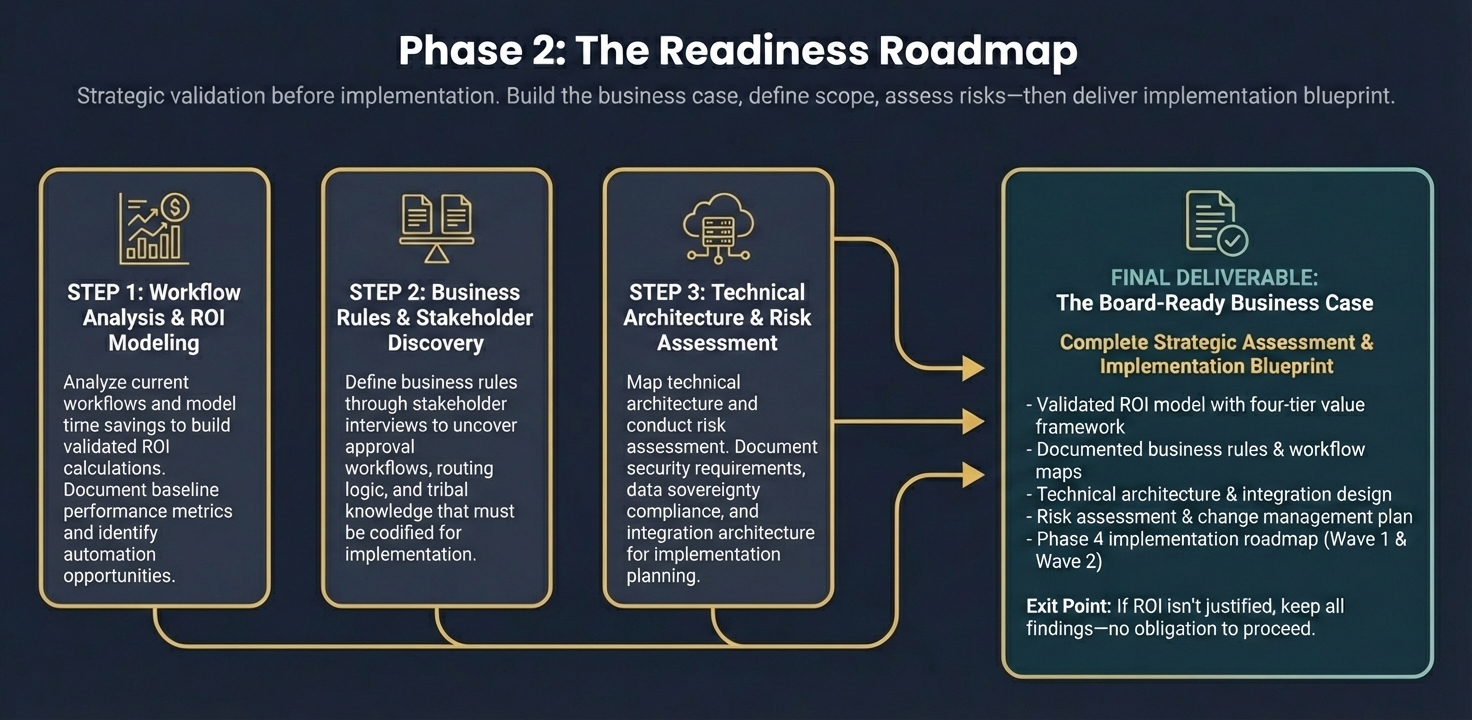
The 3-Step Discovery Protocol: Workflow Analysis, Business Rules Discovery, and Technical Architecture Assessment

From Validation to Implementation

Phase 1 validated THE DATA. Phase 2 validates THE ARCHITECTURE.

Phase 1 proved the AI can extract from your documents. Phase 2 proves the AI can integrate into your IT environment and workflows.

✓ Phase 1 Validated THE DATA:

  • 90%+ extraction accuracy on your documents
  • Technical feasibility confirmed
  • Safe failure modes proven (zero false positives)
  • Industry benchmark ROI ($521K+ for 50-person firm)

→ Phase 2 Validates THE ARCHITECTURE:

  • Security Readiness Review: Azure/AWS/GCP infrastructure audit
  • Workflow Engineering: Stakeholder interviews map actual bottlenecks
  • Business Rules Codification: Your approval logic (not template logic)
  • Fixed-Price Blueprint: Locked implementation scope prevents scope creep

Investment → Return Progression

$1,500
Phase 1 Validation
$7,500
Phase 2 Architecture
$50K-$100K
Phase 4 Deploy*
$521K+
Annual Value

Phase 2's $7,500 investment prevents $50K+ in scope creep and deployment failures

*Phase 4 cost varies by scope

Why Not Skip Phase 2 and Start Building?

Phase 2 prevents the three most common AI implementation failures

1. Scope Creep

Without Phase 2: "Just one more workflow" turns $50k into $120k mid-project.

With Phase 2: Fixed-price blueprint locks scope upfront. Business rules codified before code is written.

2. Security Blocks

Without Phase 2: Deployment blocked by IT because Azure permissions weren't audited upfront.

With Phase 2: Security Readiness Review validates infrastructure compatibility before build starts.

3. Adoption Failure

Without Phase 2: Staff refuse to use the tool because we didn't interview them about actual bottlenecks.

With Phase 2: Workflow interviews reveal approval logic. Change management plan addresses resistance.

Bottom Line: Phase 2's $7,500 investment prevents $50K+ in implementation failures by validating architecture, workflows, and scope before code is written.

The Final Deliverable: The Board Pack

Evidence-based documentation for IT, Finance, and Leadership sign-off.

Technical Readiness

  • Security Readiness Review: Azure/AWS/GCP infrastructure audit with permission scoping
  • Architecture Blueprint: M365 integration design ensuring 100% Data Sovereignty
  • Business Rules Schema: Mapped audit of the "Human Logic Gap" across 50 documents
  • Failure Logs: Documentation of "Safe Failure" modes for edge cases

Financial Validation

Based on YOUR workflows (not generic 10 Admin / 25 Junior staff benchmarks)

  • Four-Tier ROI Model: Conservative, probable, and optimistic scenarios using YOUR staff counts
  • Verified Workflow Baseline: Actual time-motion study results (not industry averages)
  • 18-Month Payback: Calculated from interviewed workflows (not template formulas)

Implementation Governance

  • Fixed-Price Blueprint: Locked implementation scope prevents scope creep
  • Risk Register: Change management plan with adoption strategy and training requirements
  • Wave 1 & Wave 2 Roadmap: Phased deployment plan with clear milestones
  • IP Handover Plan: Guarantee of 100% source code ownership—zero vendor lock-in

Exit Point: If the ROI analysis doesn't justify implementation, you keep all Phase 2 findings—workflow documentation, business rules, and architecture assessment—with no obligation to proceed to Phase 4.

What About Phase 3?

Phase 3 (Compliance Shield) is optional and assessed during Phase 2.

✓ Who Needs Phase 3?

  • Large enterprises (100+ staff) with formal governance frameworks
  • Regulated industries (legal, finance, healthcare) with PI insurance requirements
  • Strict security protocols (ISO 27001, SOC 2 compliance)
  • Publicly traded companies with external audit obligations

Phase 3 deliverables: ISO 27001 control mapping, PI Insurance questionnaire, Risk Control Matrix, pre-filled compliance questionnaires

→ Who Can Skip Phase 3?

  • Small-medium firms (<100 staff) without formal compliance frameworks
  • Existing M365/Azure governance (Phase 2 validates compatibility)
  • Fast-moving deployments (Wave 1 only, no complex ERP integration)
  • Low regulatory burden (no external audit requirements)

Most clients skip Phase 3: Phase 2 determines if compliance documentation is required for your deployment.

Decision Point: Phase 2 assessment determines if Phase 3 is required. If you operate within M365/Azure governance with no external audit obligations, you'll likely proceed directly to Phase 4 implementation.

Phase 4 Implementation: Validated Timeline

The Protocol targets an 8-12 week production sprint. This timeline is a de-risked estimate contingent on Phase 2 infrastructure and business rules validation.

Weeks 1-2: Environment & Security Config
Weeks 3-6: Workflow Build & Testing
Weeks 7-10: UAT & Staff Training
Weeks 11-12: Production & Hypercare

Wave 1 deployment only. Wave 2 expansion requires additional scoping based on Phase 2 roadmap.